 Back Row Questions
A game show host found a loophole and won eight straight
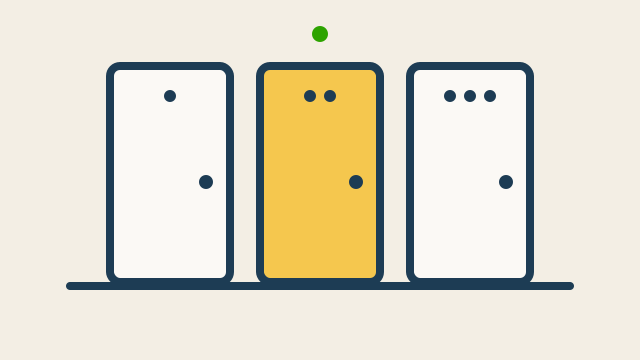
Three doors hide a car and two goats. You pick a door; the host, who knows where the car is, opens one of the other doors to show a goat and offers you the switch.
Play the game yourself
You picked door 2. The host opened door 3 to show a goat. You can keep your door or switch to door 1.
The explanation is under the game, in “What the experiment shows”.
- Place
- Pick
- Open
- Offer
- Result
- Case
Seen a game or two? Run a simulation: the page plays a hundred games for you.
The video is coming soon.
- Games played
- 0
- Games with an offer
- 0
- Matching your case
- 0
| Choice | Wins / offers | This run | Exact | Tierney, 1991 |
|---|---|---|---|---|
| Stay | ||||
| Switch |
Seed, series and list of games
The same seed gives the same games in every language.
The first games
| Game | Car | Pick | Opened | Wins | Case |
|---|
Every case
Answers and highlights
- Shows where the car is. The round then counts as played with help.
- The chance that the car is behind each closed door. It counts as help too.
- Told with the result. In the host’s seat, at once.
- Wins and losses so far, for each choice and for your own.
- Hide them to guess first.
- An outline on whatever a step changed.
Everything runs in your browser. Nothing you do here leaves the page.
What the experiment shows
Switching wins exactly when your first pick was wrong, and that happens 2 times in 3.
This holds for a host who knows where the car is, always opens a door with a goat and always offers the switch. With a host who opens a door without looking, the answer changes.
In 1991 Monty Hall played the game at his dining table with a reporter, and twenty games supported this answer. Then he reread the question: nowhere does it say that the host must offer the switch every time. He began to offer it only when the reporter’s first pick was the car, and won the next eight rounds.
From the video
Each link opens the game as a scene of the video shows it.
The video